All Categories

Get in touch

- News

Home >  News

Outdoor Umbrella Fabric Coating Guide: Fluorine-Free Water Repellent vs Teflon, What Are the Environmental Differences?

2026.09.24

Many buyers sourcing outdoor umbrella and awning fabrics focus heavily on water repellency: fabrics that stay dry in rain and can be easily rinsed clean. When it comes to waterproof coatings, two terms frequently come up: Teflon (fluorinated water repellent) and fluorine-free water repellent.

A common oversimplification is that Teflon is an older technology while fluorine-free coatings are the eco-friendly option. This statement holds partial truth but can easily lead to costly mistakes. Beyond environmental performance, these two coatings differ significantly in water beading effect, wash resistance, weathering aging, cost and export compliance. Today we break down their working principles, environmental concerns, performance comparison and suitable application scenarios.

Preliminary note: This article discusses water repellent top coatings for outdoor fabrics, not substrate waterproof membranes. Water Repellent ≠ Waterproof. Outdoor umbrella and awning fabrics mostly adopt water repellent finishing.

01 Understand the two coating technologies

Teflon Water Repellent Coating (Fluorinated Finishing, C8 / C6 Fluorochemicals)

Commonly known as Teflon in the industry, it belongs to fluorocarbon-based water and oil repellent finishing agents. Principle: A low-surface-energy fluorinated film attaches to fiber surfaces. When raindrops hit the fabric, they bead up and roll off. It also delivers excellent oil repellency. Two mainstream generations available on the market:

  • C8 fluorinated: Traditional Teflon with the strongest water & oil repellency, yet highest PFAS / PFOA / PFOS risks.
  • C6 fluorinated: Modified version with shorter carbon chains, reducing long-chain perfluorinated compounds, but still falling under fluorinated systems.

✅ Advantages

  1. Outstanding water repellency and oil resistance;
  2. Good rub and wash resistance, retaining high water repellency after repeated cleaning;
  3. Better UV aging resistance. Water repellent performance degrades slower under prolonged outdoor sun exposure.

⚠️ Environmental Drawbacks (Core Controversy) Fluorinated products contain Per- and Polyfluoroalkyl Substances (PFAS), dubbed “forever chemicals”. They are extremely persistent in nature and bioaccumulate in water, soil and living organisms.

Critical reminder for foreign trade: The EU and multiple US states have rolled out PFAS bans. C8 fluorinated products are basically ruled out for EU & US shipments; C6 fluorinated products are also facing growing restrictions.

Fluorine-Free Water Repellent Coating (Fluorine-Free, Paraffin / Polyurethane Systems)

Fluorine-free water repellent formulations contain no PFAS, PFOA or PFOS. The two mainstream types are paraffin-based and polyurethane-based fluorine-free finishing agents. Principle: A hydrophobic layer forms on fiber surfaces via wax or polyurethane film formation to achieve water beading. No fluorine elements are involved.

✅ Advantages

  1. Free of persistent PFAS chemicals, better environmental degradability;
  2. Complies with EU REACH regulation and PFAS restrictions in selected US regions. Environmental compliance is its biggest selling point;
  3. Lower pollution during production, meeting domestic environmental policies and green procurement requirements from overseas buyers.

⚠️ Drawbacks

  1. Poor oil repellency, barely resistant to oil. Cooking oil and barbecue stains are hard to remove once absorbed;
  2. Inferior wash and abrasion resistance compared to Teflon. Water repellency fades faster after repeated wiping and rain erosion;
  3. Some low-grade fluorine-free formulations tend to turn sticky or chalky after long sun exposure, altering fabric hand feel.

02 Core Comparison: Environmental Performance, Function & Cost

🌱 Environmental Performance (Focus of this article)

  • Teflon (Fluorinated C6 / C8): Contains PFAS. C8 PFOA / PFOS are highly persistent and bioaccumulative. Although C6 does not contain PFOA / PFOS, it still belongs to the PFAS family and is restricted under many new overseas regulations. Trace fluorinated substances may enter the environment during production, usage and disposal, bringing high environmental risks.
  • Fluorine-Free Water Repellent: No PFAS in formulation, eliminating the risk of “forever chemical” accumulation. Less degradation pressure for waste products. ✅ Ideal for green supply chains, carbon-neutral projects and eco-focused orders from European and American brands.

Myth correction: Fluorine-free does not equal zero pollution. Fluorine-free auxiliaries are still chemical products; they simply exclude highly persistent PFAS and are not 100% natural.

💧 Water Repellency & Stain Resistance

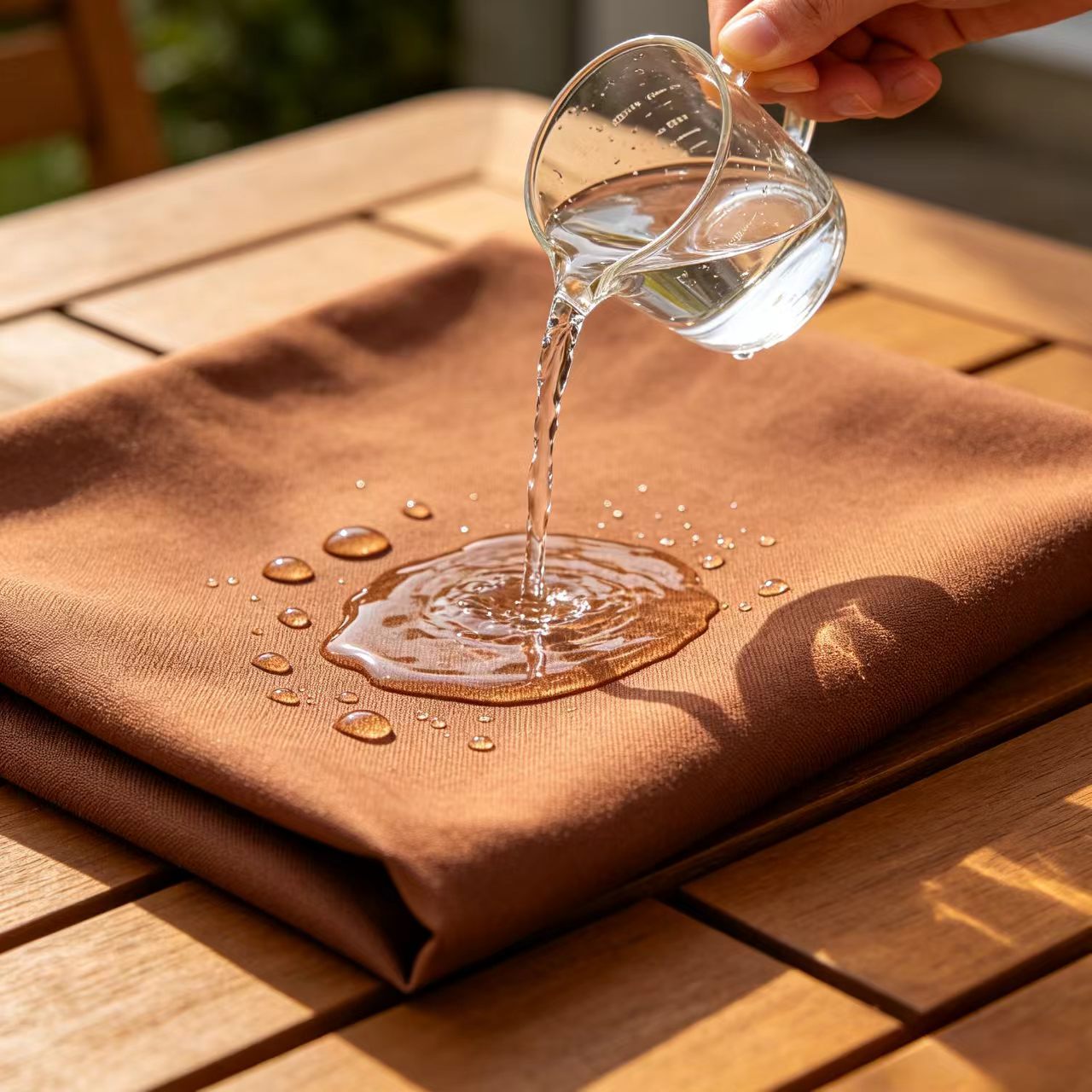
  • Teflon: Dual water and oil repellency. Strong water beading effect; oil stains hardly penetrate the fabric.
  • Fluorine-Free Water Repellent: Only water beading performance, no oil resistance. Oil contamination becomes a major pain point for outdoor dining and glamping applications.

☀️ Outdoor Weather Resistance (Key Index for Umbrella & Awning Fabrics)

  • Teflon: UV and rain erosion resistant, longer coating service life, suitable for permanent outdoor exposure.
  • Fluorine-Free Water Repellent: Wide performance variance. Premium fluorine-free formulations offer acceptable weather resistance; regular fluorine-free grades lose hydrophobicity rapidly under prolonged sunlight.

🧺 Hand Feel

  • Teflon: Thin coating, minimal impact on fabric hand feel; fabric remains soft.
  • Paraffin-based fluorine-free: Some low-cost variants create a waxy, stiff hand feel. High-grade PU fluorine-free improves hand feel but raises costs.

💰 Cost At equal water repellent rating: Teflon (C6) < high-performance fluorine-free. Low-cost fluorine-free auxiliaries come with poor performance. If you need fluorine-free treatment with solid weather resistance, the cost will exceed C6 Teflon.

03 Fabric Selection Guide: Match Coatings to Your Application

✅ Choose Fluorine-Free Water Repellent Coating for these scenarios

  1. Orders shipped to the EU, California, Maine and other regions with PFAS regulations;
  2. Brand clients explicitly requiring eco-friendly, PFAS-free and sustainable fabrics;
  3. Patio shading and standard outdoor umbrellas, mainly for rain protection with minimal oil exposure;
  4. Government projects, boutique homestays and campgrounds where clients value eco-friendly marketing highlights.

✅ Choose Teflon C6 Fluorinated Coating for these scenarios

  1. Domestic projects with no mandatory PFAS environmental regulations;
  2. Commercial outdoor seating and restaurant patio umbrella fabrics exposed to frequent food oil stains;
  3. Fabrics requiring repeated cleaning and long-lasting water repellency;
  4. High-sunlight, rainy coastal environments where extended coating service life is required.

04 Clarification of 3 Common Industry Misconceptions

❌ Misconception 1: Teflon is toxic and harms human skin upon contact Fact: Cured Teflon coating on finished fabric remains stable at room temperature. The risk does not come from direct skin contact with finished goods. The hazard arises when PFAS enters the environment during production and disposal, causing long-term bioaccumulation. It is an environmental persistent pollutant rather than an immediate skin toxin.

❌ Misconception 2: Fluorine-free treatment delivers permanent water repellency Fact: All water repellent coatings wear off over time. Rain scouring, dust and UV radiation break down the hydrophobic layer. Fluorine-free coatings generally degrade faster than C6 Teflon and require maintenance over time.