With years of experience in outdoor fabric foreign trade, I notice many clients share the same pitfall when selecting waterproof fabrics. They only check the immediate water beading effect, while overlooking ageing rate, outdoor weather resistance, and most importantly, environmental compliance requirements for export markets.
Although all these fabrics are labelled “waterproof”, some remain stable for 2–3 years, while others turn sticky and peel off within half a year. Worse still, some shipments get detained at overseas customs due to non-compliance with environmental regulations.
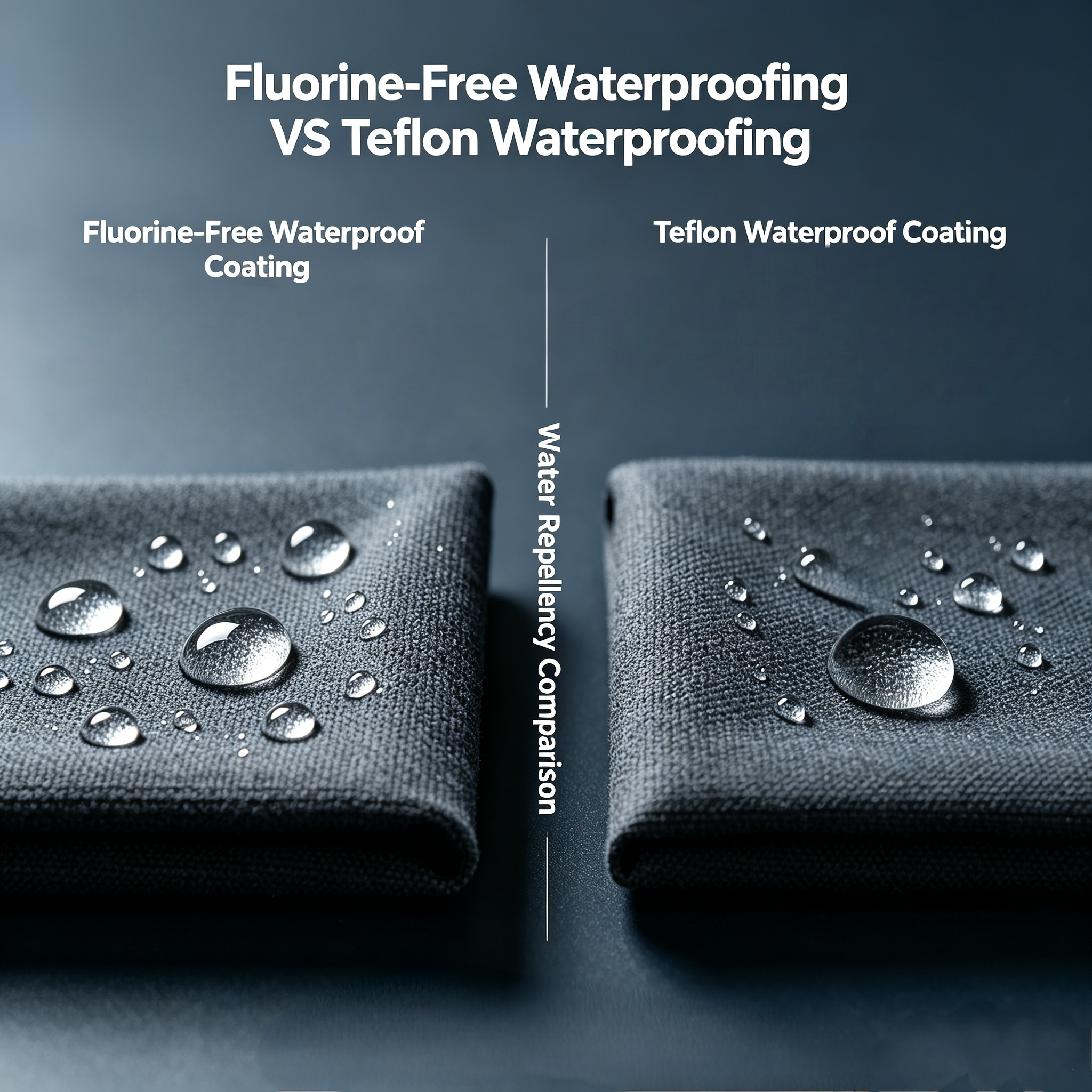
First, let’s clarify a core distinction: Teflon and fluorine-free treatments are surface water-repellent finishes, relying on the lotus-leaf effect to repel water. PU and PVC are back-coating waterproof systems, forming a polymer film to physically block water penetration.
Teflon delivers outstanding water, oil and stain repellency. The fabric maintains a dry hand feel, making it easy to wipe off spills and dirt. It used to be widely adopted for commercial outdoor seating.
However, it has obvious limitations. It is merely a surface treatment and cannot withstand prolonged heavy rain immersion. After long-term sun exposure and rain washout, its water and stain repellency gradually deteriorates. Under regular open-air conditions, performance noticeably drops after 1–2 years of use.
What matters more is tightening environmental regulations. Traditional fluorinated Teflon formulations are heavily restricted in mainstream markets including the EU, the US and Australia, so they are not recommended for long-term high-end export orders.
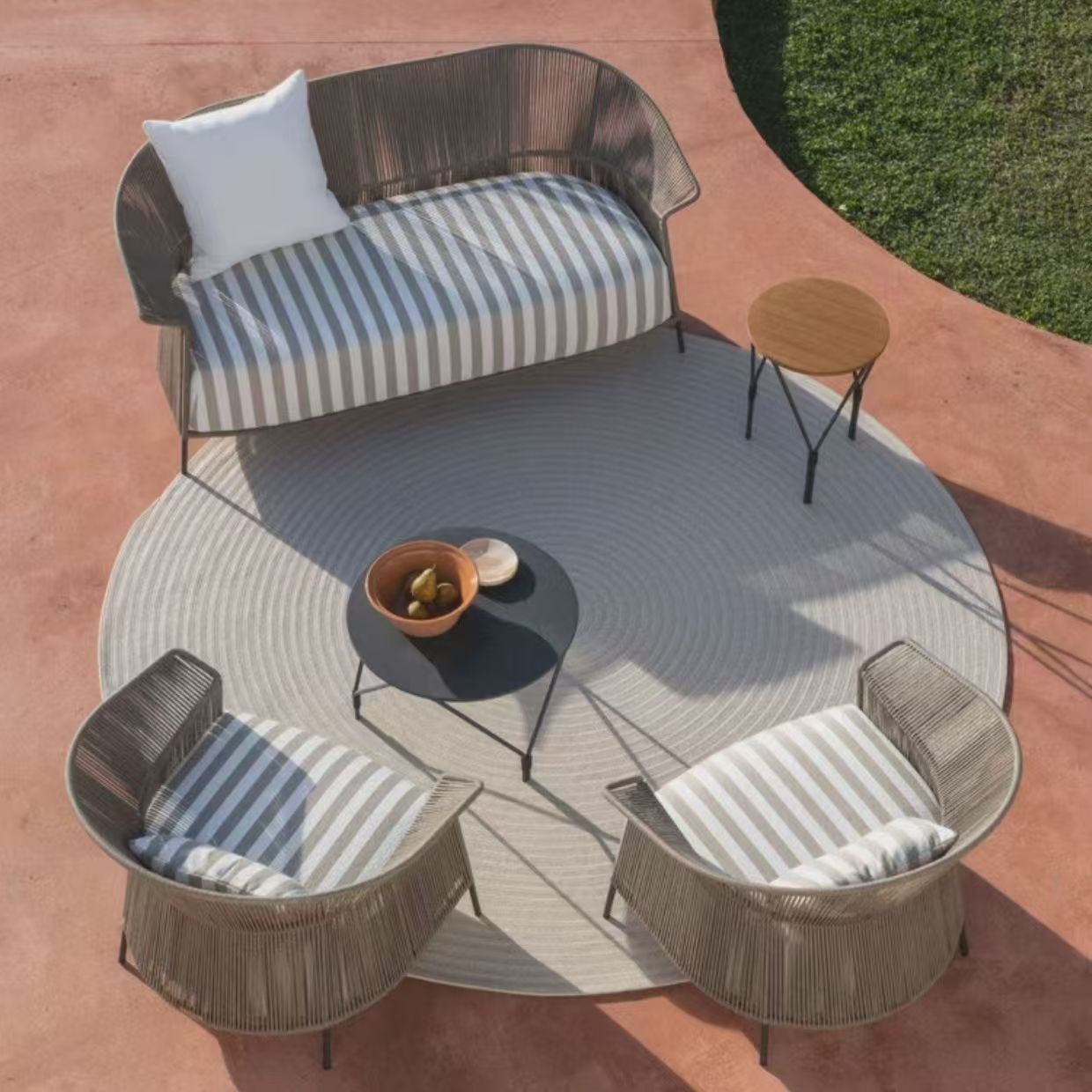
PU coating is the most widely used barrier solution for outdoor sofa and awning fabrics. A waterproof membrane forms on the fabric back, offering high hydrostatic pressure and excellent water-blocking performance suitable for continuous rainfall in wet overseas regions. It features soft hand feel and balanced cost performance.
When formulated properly, PU passes REACH, California Proposition 65 and other standard tests, compatible with most global markets.
Pay close attention to ageing risks. Conventional PU tends to hydrolyse, grow mould, turn sticky and delaminate under high temperature, high humidity and coastal salt spray. For orders destined for rainy and humid areas, weather-resistant modified PU is strongly recommended, with a stable service life of 2–3 years.
PVC coating is thick, abrasion-resistant and fully impermeable at a competitive price, ideal for engineering projects and low-cost outdoor applications.
Its outdoor weather performance is unsatisfactory. The fabric feels stiff and lacks breathability. It struggles greatly in regions with large temperature swings: it softens and gets sticky under hot sunlight, yet becomes brittle, yellow and peels off in cold weather.
Due to environmental concerns, PVC is largely banned by high-end EU/US markets and brand retailers. It is only fit for low-volume, low-end markets and not suggested for residential patio upholstery or premium export projects.
Driven by global fluorine-free environmental trends, fluorine-free waterproofing has become a mandatory specification for high-end orders to Europe, America and Australia. Free from PFOA and PFOS, it carries no fluorine-related compliance risks and clears customs smoothly. It is the mainstream choice for overseas brands developing eco-friendly outdoor soft furnishings.
It preserves the fabric’s natural soft touch without altering the original texture, perfect for luxury patio sofas, boutique 民宿(boutique homestay)and branded outdoor seating.
Objectively speaking, fluorine-free treatment is a water-repellent finish rather than a barrier coating. It cannot resist prolonged immersion under heavy rain, even though it works well against daily showers. Its abrasion resistance and weathering performance are slightly inferior to Teflon. Slow performance degradation after 1–2 years of outdoor use counts as normal wear and tear.
After years in this industry, I firmly believe there is no single best waterproof treatment. The right solution depends on your target market, application scenario and budget.
Choosing the proper finish improves product quality, drastically reduces overseas complaints and customs risks, and makes every shipment stable and worry-free.

Suzhou Ruihe Textile & Technology Co.,Ltd
Copyright © Suzhou Ruihe Textile & Technology Co.,Ltd All Rights Reserved | Blog | Privacy Policy

 EN
 AR
 NL
 FR
 DE
 HI
 IT
 JA
 KO
 PT
 RU
 ES
 TL
 IW
 ID
 VI
 TH
 TR
 FA